It’s been a good few months since I’ve started my journey to crafting my thesis project. In the Spring, I took the first course (out of two) that allowed me to work on the initial stages of my project. The first course, together with the second course (this semester, in the Fall of 2020), serve as a whole crafting experience and completion of my thesis. But, I am still not there yet, as it is still a work in progress. But so far, I am somewhat satisfied with what I have accumulated so far, since this is a demanding project and I fear having something good is never enough.
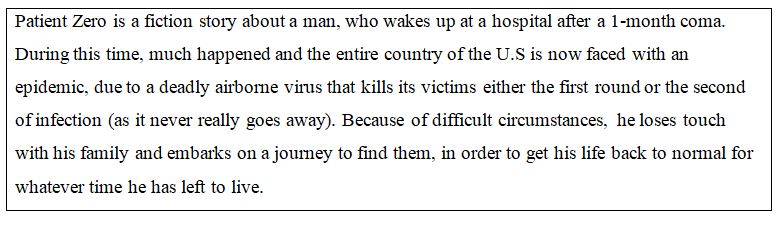
To properly make sense of my work and the current progress of it, I like to briefly give a description about my creative project.
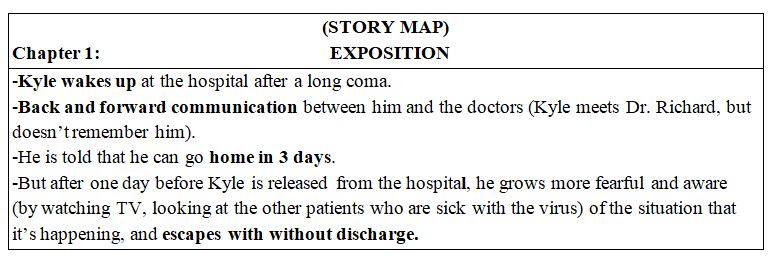
In to come up with this creative fictional story, I had to obviously do some planning and brainstorming of ideas. And so, I found myself developing a short-of-outline (Story Map, as I call it) that would depict the story line. Because the project is not necessary short, I had to develop a series of chapter that were detailed with the various important events that would take place as part of the story. I also focused on arranging this outline in a way that would have a standard creative writing and story-telling technique, which would improve the flow of the narration and story progression. This writing technique I speak of consists of a popular format: exposition/ introduction, rising action, climax, falling action, and conclusion/ resolution.
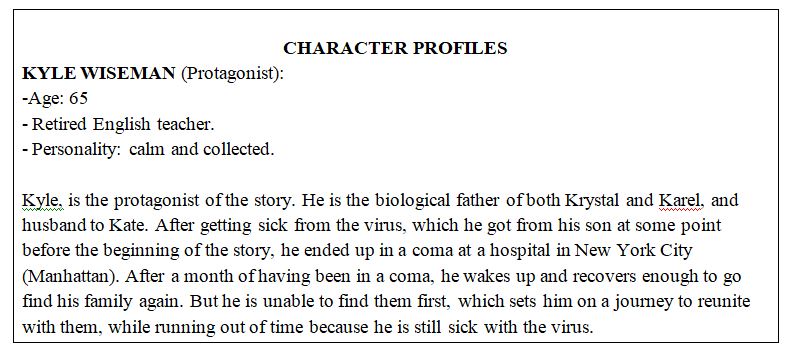
In addition to this, during this stage of crafting of my project, I was also working on something I like to call “Character Profiles”, which consists of detail profiles and descriptions of all characters found in the work. These profiles are not as simple as just writing a name of a character and giving it a role, but also giving them motives, personality traits, conflicts, and much more, in order to make them as dynamic as possible. My character profiles are so important, that when the actual writing of the work starts, I always go back and forward between this sheet and a manuscript, to make the character feel more real.
After having put this big puzzle together and visualizing it in my mind over and over, I started to have more confident in writing the manuscript, which is basically that space or created world where the story comes alive. To some people, this might be the easiest part, but for me is always the most challenging. The actual writing of a story can sometimes take too much into consideration, depending on the type of project. At least, this was the case with my project, and so I tried to first memorize well my story-plan consisting of all of the above which I previously mentioned. I needed to familiarize myself with my work, so that I knew exactly what to say and how to say it, according to all of the settings I build for the work. I visualized the characters in my head over and over, and learned them as if I lived with them at my own house (as if they were real people).
Also, practiced visualizing strategies of each chapter I was going to write, over and over to not deviate myself from my story progression. I addition, something else that happened behind the scenes of my manuscript writing was more memorizing practices of dialog, sentences, and phrases, which I wanted for each character to say. The purpose of this was to keep a consistency of character distinction and characteristics for the writing to feel immersive. The interesting thing about this is that the finish product is something the reader only sees through an outside point of view, and rarely ever thinks about what the various tricks, techniques, and strategies a writer adopts when crafting such writing. Knowing this, I still keep my process of writing because it would benefit my work in many ways.
Over the months, until now, I kept this somewhat complex writing process for my manuscript, and kept adding more chapters and filling up the gap to completion. But course, I am still not there yet, and I still have a bit more of time. Now, I have been faced with another layer of work for my project, which we call it the Lit-Review. I have to say, that it took me some good time to actually grasp adequate understanding of how to go about this part of my project. But thanks many feedback, class meetings, and advice from peers and my instruction (Dr. Zamora), I am more aware of how to approach it. And so far, I feel good about my work on this area too, which is something I couldn’t see a few months ago. But each time, I’m starting to see that this project is like climbing a mountain, and thus it takes time and patience to reach the top. But I’m hopeful that I will make it to the top, if not with this project, then with another one. For now, I’ll continue on this journey, and only time will tell the outcome at the end.
 KARELTHESISPROJECT